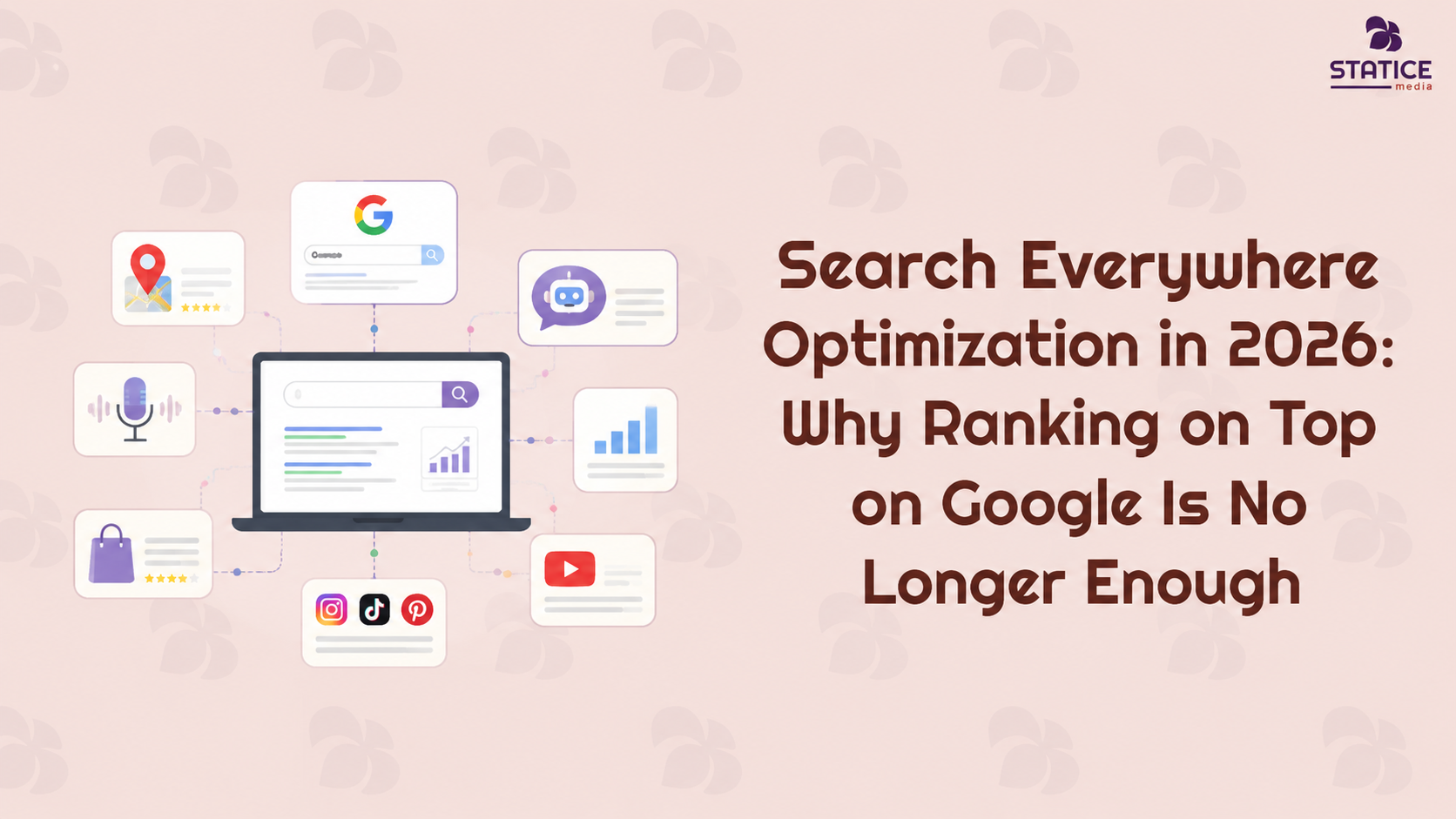
Search Everywhere Optimization in 2026: Why Ranking on top on Google Is No Longer Enough
For years, digital visibility had one dominant goal: rank higher on Google.
Businesses invested in SEO, targeted the right keywords, built backlinks and created content designed to reach the first page of search results.
That still matters.
But in 2026, the way people discover businesses, compare solutions and make decisions has changed significantly.
Someone looking for a digital marketing agency might Google it. Another person might ask ChatGPT or Gemini for recommendations. Someone else may search Instagram for agency work, watch YouTube videos, browse Reddit discussions or discover a company through LinkedIn.
Even Google itself is evolving through AI-powered search experiences such as AI Overviews and AI Mode.
The result is a simple shift:
Your customers are searching everywhere. Your brand needs to be visible everywhere too.
Welcome to the era of Search Everywhere Optimization.
What Is Search Everywhere Optimization?
Search Everywhere Optimization is the practice of making your brand discoverable across the different platforms people use to search for information, products, services and recommendations.
Traditional SEO primarily focuses on improving visibility within search engines.
Search Everywhere Optimization expands that thinking.
Today, discovery can happen across:
- Google Search
- Google AI Overviews and AI Mode
- ChatGPT
- Gemini
- Claude
- Other AI-powered answer engines
- YouTube
- Online communities
- Review platforms
- Maps and local search
The objective is no longer simply to rank for a keyword.
It is to ensure that when a potential customer asks a relevant question — wherever they ask it — your brand has a chance of being found, understood, trusted and recommended.
Why Search Behaviour Is Changing
The traditional customer journey was relatively straightforward.
A user would search for something on Google, click through to a website, compare a few options and make a decision.
Today’s journey is far more fragmented.
A potential customer might first discover a company through Instagram, later search for its reviews on Google, read the founder’s LinkedIn posts, visit the website and finally ask an AI assistant to compare that company with two competitors.
Every one of these touchpoints contributes to the final decision.
That is why businesses need to think beyond rankings alone.
1. Google Search Is Becoming More Conversational
Google is not disappearing. It remains one of the most important discovery channels for businesses.
But the Google experience itself is changing.
Instead of always typing short queries such as:
“best interior designer Bangalore”
users can increasingly search with much more detailed questions:
“Which interior design companies in Bangalore specialise in premium apartments and have experience working on modern minimalist homes?”
AI-powered search experiences are designed to handle these longer, more conversational searches.
This changes how businesses should think about content.
Pages should not simply target individual keywords. They need to answer genuine customer questions, explain services clearly and demonstrate subject expertise.
Traditional SEO fundamentals still remain critical.
Your website must be:
- Crawlable
- Indexable
- Technically sound
- Mobile-friendly
- Easy to navigate
- Structured clearly
- Useful to real users
SEO isn’t disappearing.
It is becoming one part of a much larger search ecosystem.
2. AI Platforms Are Becoming Discovery Engines
Search behaviour is also extending beyond traditional search engines.
People increasingly ask AI platforms questions that previously would have required several separate Google searches.
For example:
- Which CRM is best for a 20-person sales team?
- Recommend digital marketing agencies for a manufacturing company.
- What should I look for when choosing a solar installation company?
- Compare these three software providers.
- Which restaurants are worth visiting during a weekend in Singapore?
This creates an entirely new challenge for businesses.
It is no longer enough for your website to contain the right keywords.
AI systems need enough credible information about your brand, expertise, services and reputation to understand who you are, what you do and when you are relevant.
This is where Answer Engine Optimization (AEO) and Generative Engine Optimization (GEO) become increasingly important.
Your website content, digital authority, third-party references, reviews and overall brand footprint can all contribute to how clearly your business is represented online.
3. Social Media Has Become a Search Platform
Think about how people discover restaurants, travel destinations, products, creators or service providers today.
A significant amount of that discovery now happens through social media.
Users search Instagram for terms such as:
- cafes in Indiranagar
- wedding photographers Bangalore
- Japan itinerary
- home decor ideas
- digital marketing tips
- branding inspiration
YouTube has long functioned as one of the world’s largest informational search platforms.
LinkedIn increasingly plays a similar discovery role for professionals, consultants, founders and B2B companies.
This means social media content should not only be designed for existing followers.
It should also be designed for discoverability.
Useful captions, relevant keywords, descriptive video titles, educational content, strong profile optimisation and consistent subject expertise can all improve the likelihood of your content being discovered.
The line between social media marketing and search marketing is becoming increasingly blurred.
4. Your Brand’s Digital Footprint Matters More Than Your Website Alone
A company can say anything about itself on its own website.
Customers have many more signals available to evaluate whether those claims are credible.
They can look at:
- Google reviews
- Customer testimonials
- Reddit discussions
- LinkedIn content
- Media mentions
- Industry directories
- YouTube videos
- Social media conversations
- Case studies
- Third-party articles
This means digital visibility increasingly depends on building authority beyond your own domain.
Consider two companies offering an identical service.
Company A has a well-optimised website but almost no presence elsewhere.
Company B has a strong website, active social profiles, customer reviews, useful thought-leadership content, detailed case studies and mentions across reputable websites.
The second company creates significantly more trust signals for both customers and digital discovery platforms.
Search Everywhere Optimization therefore isn’t simply an SEO exercise.
It is also a brand-building exercise.
5. Your Website Still Remains the Foundation
With all the discussion around AI search and social discovery, it can be tempting to assume that websites are becoming less important.
In reality, your website remains one of the most important digital properties your business controls.
It tells search engines, AI systems and potential customers:
- Who you are
- What you offer
- Who you work with
- Where you operate
- What expertise you have
- What questions you can answer
- Why customers should trust you
A technically strong website also provides the structured information that search engines and other discovery platforms need to understand your business.
The difference is that your website should no longer exist in isolation.
It should work alongside your content, social media presence, reviews, brand authority and wider digital ecosystem.
The Statice Search Everywhere Framework
At Statice Media, we believe modern digital visibility can be viewed through four connected stages:
Be Found
Make sure your brand can be discovered across:
- Search engines
- AI-powered search
- Social platforms
- Maps
- Relevant digital communities
This is where SEO, AEO, GEO and social discovery come together.
Be Understood
Being visible is not enough if people cannot quickly understand your business.
Your website and content should clearly communicate:
- What you do
- Who you serve
- What makes you different
- Where you operate
- Why your expertise matters
Clarity improves both customer experience and digital discoverability.
Build Trust
Customers rarely make decisions based on a single search result.
Trust is built through:
- Customer reviews
- Case studies
- Testimonials
- Thought leadership
- Useful content
- Brand consistency
- Media and industry mentions
- A strong visual identity
These signals help reinforce why your business should be considered.
Convert
Visibility ultimately needs to contribute to business results.
Your website, landing pages, paid campaigns and remarketing ecosystem should help turn discovery into:
- Enquiries
- Calls
- Bookings
- Demo requests
- Purchases
- Qualified leads
The objective is not simply to appear everywhere.
It is to build a connected journey from discovery to conversion.
What Should Businesses Optimize for in 2026?
Search Everywhere Optimization does not mean creating accounts on every platform and publishing content everywhere.
It means understanding where your customers discover information and building a connected presence across the channels that matter.
Here are seven areas businesses should prioritise.
1. Build a Strong SEO Foundation
Make sure search engines can crawl and understand your website.
Focus on:
- Technical SEO
- Search intent
- Useful service pages
- Strong website architecture
- Internal linking
- Mobile usability
- Relevant and original content
- Clear page titles and descriptions
SEO remains the foundation on which broader digital visibility is built.
2. Create Content That Answers Real Questions
Instead of creating articles simply because a keyword has search volume, think about the questions customers ask before buying.
Your content should answer questions such as:
- How does this service work?
- How much does it cost?
- Which option is right for me?
- What are the differences between two solutions?
- What mistakes should I avoid?
- How do I choose the right provider?
- What should I expect before getting started?
Clear and genuinely useful answers work well for humans, traditional search engines and AI-powered discovery experiences alike.
3. Strengthen Your Brand Authority
Search visibility is not only about what you publish.
It is also about what the wider internet knows about your business.
Build authority through:
- Customer reviews
- Detailed case studies
- Expert insights
- Industry collaborations
- Relevant backlinks
- Media mentions
- Thought leadership
- Consistent brand information
The objective is to demonstrate expertise, rather than simply claim it.
4. Create Platform-Native Content
One blog should not simply be copied and pasted across five different platforms.
Instead, one strong idea can become:
- A detailed website article
- A LinkedIn opinion post
- An Instagram carousel
- A short Reel
- A YouTube explainer
- An email newsletter
- A series of FAQs
The underlying message stays consistent, while the format adapts to how people consume content on each platform.
This allows one piece of expertise to create multiple discovery opportunities.
5. Make Your Brand Easy to Understand
Consistency matters.
Your website, Google Business Profile, social media profiles, directories and other listings should clearly communicate the same core information about:
- Your brand name
- Services
- Locations
- Expertise
- Target audience
- Brand positioning
If your online presence sends conflicting signals about what your business does, both customers and discovery platforms may struggle to understand your brand.
6. Think Beyond Website Traffic
Traditionally, SEO performance has often been simplified into:
Rankings → Clicks → Website Traffic
That measurement model is becoming incomplete.
Businesses should increasingly consider a wider group of indicators such as:
- Search visibility
- Branded searches
- AI visibility
- Qualified website traffic
- Brand mentions
- Social engagement
- Leads and enquiries
- Assisted conversions
- Share of voice
The ultimate goal isn’t more visitors.
It is more relevant discovery that contributes to business growth.
7. Build an Integrated Digital Marketing Strategy
SEO, social media, branding, content, paid marketing and website development are often treated as completely separate activities.
Search Everywhere Optimization shows why that approach is becoming outdated.
A useful article can improve Google visibility.
That same insight can become a LinkedIn post.
Parts of it can become an Instagram carousel or short video.
A potential customer may discover the company through social media, Google the brand, check its reviews, visit the website and later ask an AI assistant to compare it with competitors.
No single channel receives complete credit for the final conversion.
But every touchpoint contributes.
That is why businesses increasingly need a connected digital ecosystem instead of disconnected marketing activities.
SEO vs AEO vs GEO vs Search Everywhere Optimization
These terms can sound more complicated than they actually are.
SEO: Search Engine Optimization
SEO helps websites and content become discoverable through traditional search engines such as Google.
It includes technical optimisation, content strategy, keyword targeting, website structure, backlinks and user experience.
AEO: Answer Engine Optimization
AEO focuses on structuring information so that answer-based systems can easily understand and surface it when users ask questions.
Clear FAQs, direct answers and well-structured content are particularly useful here.
GEO: Generative Engine Optimization
GEO focuses on improving brand and content visibility within generative AI experiences.
This increasingly involves strong content, authority, brand mentions, structured information and credibility across the web.
Search Everywhere Optimization
Search Everywhere Optimization connects the bigger picture.
It recognises that modern discovery happens across traditional search, AI platforms, social media, video, online communities and other digital channels.
Businesses do not necessarily need four completely independent strategies.
They need one strong digital strategy designed around how customers actually discover brands today.
Is Ranking #1 on Google Still Important?
Absolutely.
High Google rankings can still generate enormous visibility, qualified traffic and leads.
But ranking #1 should no longer be considered the finish line.
A modern business should ask broader questions:
Can customers find us on Google?
Can AI platforms understand what we do?
Do we look credible when someone researches our brand?
Can people discover our expertise through social media?
Does our website provide the information they need?
Does our digital presence consistently communicate why they should choose us?
That is the difference between simply ranking and actually being discoverable.
Final Thoughts
The future of search isn’t about Google versus ChatGPT, SEO versus GEO or websites versus social media.
It is about recognising that customer journeys are becoming increasingly fragmented.
Someone may discover your company through Instagram, research you on Google, read your LinkedIn content, visit your website, check reviews and use an AI assistant to compare you with competitors before ever contacting you.
Businesses that optimise only for one stage of that journey risk becoming invisible during the others.
Search Everywhere Optimization is about building a brand that can be discovered, understood and trusted wherever your customers choose to search.
At Statice Media, we bring together strategy, branding, content, SEO, AEO, GEO, social media, paid marketing and website development to help businesses build connected digital ecosystems rather than isolated marketing channels.
Because in 2026, visibility isn’t just about being ranked.
It’s about being found.
Frequently Asked Questions
What is Search Everywhere Optimization?
Search Everywhere Optimization is a digital marketing approach focused on improving a brand’s discoverability across traditional search engines, AI platforms, social media, video platforms, online communities and other places where customers search for information.
Is Search Everywhere Optimization replacing SEO?
No. SEO remains an important foundation. Search Everywhere Optimization expands the strategy by considering additional discovery channels such as AI search, social search and online communities.
What is the difference between SEO, AEO and GEO?
SEO focuses primarily on search-engine visibility. AEO helps content become easier for answer engines to understand and surface, while GEO focuses on improving visibility within generative AI platforms and AI-generated responses.
How can businesses improve their visibility in AI search?
Businesses should maintain a technically strong website, publish clear and useful content, demonstrate genuine expertise, build brand authority, maintain consistent information across the web and earn credible third-party mentions and reviews.
Does social media affect search visibility?
Social platforms increasingly function as discovery and search channels themselves. Creating useful, searchable and platform-specific content can help brands reach people who may never begin their customer journey with a traditional Google search.
Is traditional SEO still important in 2026?
Yes. Technical SEO, useful content, strong website structure, search intent and authority remain essential. The difference is that businesses now need to think about these fundamentals as part of a wider digital discovery strategy.